
Why Am I So Bloated? Do Probiotics Help and What Actually Works
By Eddie Khoriaty, BPharm, R.Ph., C.Ph.
That uncomfortable, overly full feeling after a meal is something almost everyone experiences occasionally. Your waistband suddenly feels tighter, your abdomen feels swollen or pressured, and you may wonder what you ate or whether something has gone wrong with your digestive system.
One question I hear frequently is whether probiotics can relieve bloating or whether they are simply overhyped.
The answer is not a simple yes or no. Bloating has many possible causes, and a probiotic is not automatically the right solution. Depending on the person and the product, probiotics can sometimes temporarily increase gas and bloating.
Before reaching for a supplement, it helps to consider why you are bloated in the first place. As a pharmacist, that is how I approach the problem: identify the most likely cause, then choose the most reasonable response, which may or may not come in a bottle.
What Is Actually Happening When You Feel Bloated?
First, it helps to understand the difference between bloating and abdominal distention.
Bloating describes the sensation of fullness, pressure, or swelling in the abdomen. Distention means the abdomen has actually increased in size. You can feel extremely bloated without having significant visible distention.
Gas may contribute to bloating, but it is not always the entire explanation. Bloating can also be associated with:
- Swallowed air
- Gas produced when intestinal bacteria ferment certain carbohydrates
- Constipation
- Changes in how quickly food moves through the digestive tract
- Food intolerances
- Increased sensitivity to normal amounts of gas or stool
- Changes in communication between the gut and brain
- Irritable bowel syndrome (IBS)
- Hormonal changes
- Certain medications
- Less commonly, an underlying gastrointestinal or medical condition
That's why describing bloating simply as “trapped gas” is an oversimplification.
Interestingly, some people who experience significant bloating do not necessarily produce excessive amounts of gas. Their digestive system may simply be more sensitive to normal intestinal activity. That is an important part of digestive health that often gets overlooked.
Common Everyday Causes of Bloating
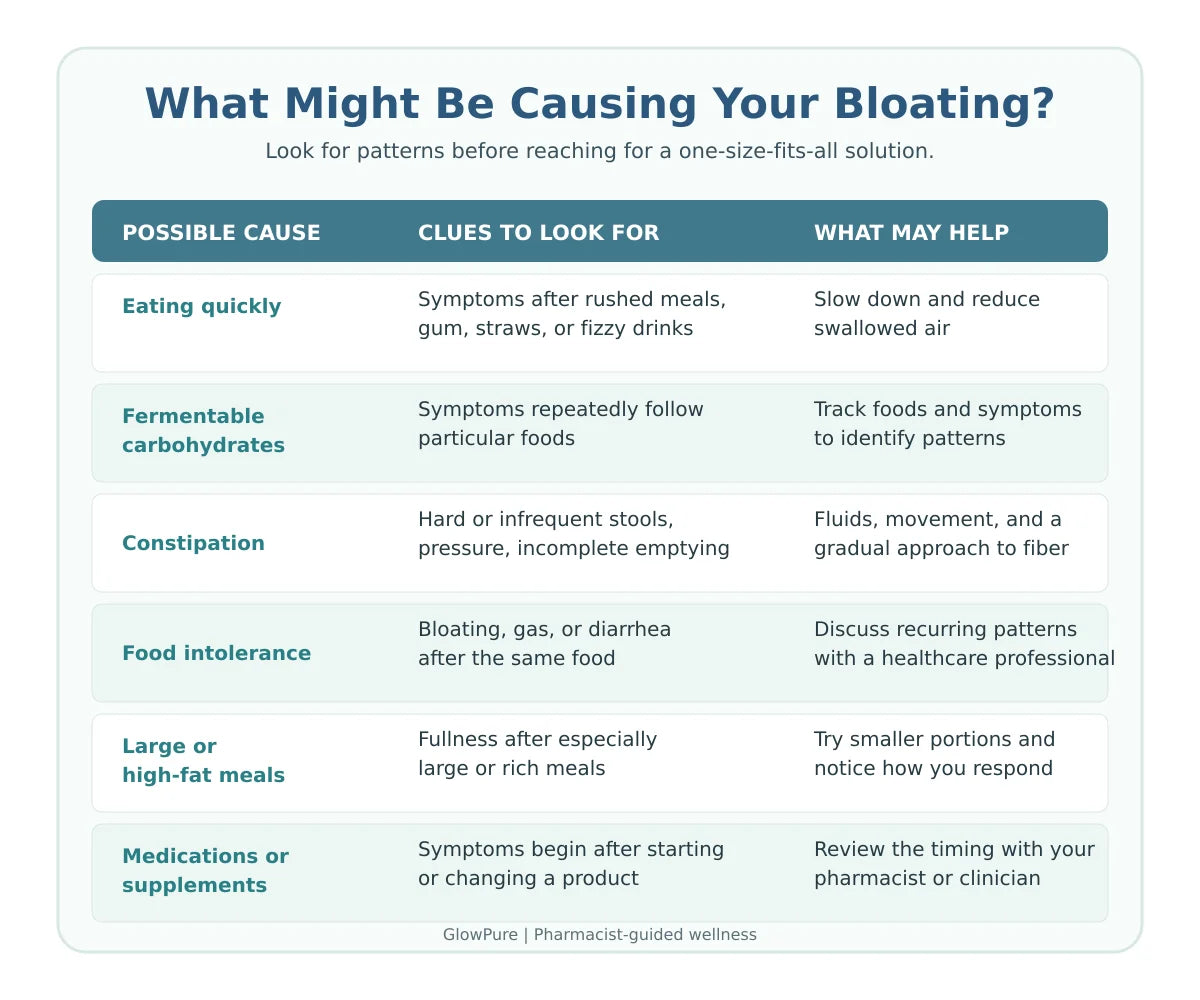
If bloating happens occasionally, particularly after meals, the cause may be surprisingly simple.
Eating too quickly
Eating quickly, talking while eating, chewing gum, drinking through a straw, and consuming carbonated beverages can all increase the amount of air you swallow. Slowing down and reducing carbonated drinks may make a noticeable difference.
Certain carbohydrates
Some carbohydrates are not completely absorbed in the small intestine. When they reach the colon, intestinal bacteria ferment them and produce gas. These include some foods commonly described as high-FODMAP foods, such as:
- Beans and legumes
- Certain fruits and dairy products
- Wheat-containing products
- Onions and garlic
- Cruciferous vegetables
- Sugar alcohols such as sorbitol, mannitol, xylitol, and erythritol
That does not make these foods unhealthy. Many are extremely nutritious. The question is whether a particular food consistently triggers symptoms for you.
Constipation
Constipation is one of the first things I consider when someone experiences frequent bloating. When stool remains in the colon longer, abdominal fullness, pressure, and gas can become more noticeable.
Fluids, physical activity, and an appropriate amount of fiber may help. However, suddenly adding large amounts of fiber can temporarily make bloating worse. For a closer look at common causes, treatment options, and warning signs, read our pharmacist’s guide to constipation.
Food intolerances
Someone with lactose intolerance may develop bloating, gas, abdominal discomfort, or diarrhea after consuming lactose. Other poorly absorbed carbohydrates can cause similar symptoms.
If the same food repeatedly causes problems, keeping a simple food-and-symptom record for a week or two may help reveal a pattern.
Large or high-fat meals
Sometimes the volume of a large meal is enough to create an uncomfortable feeling of fullness. High-fat meals may also contribute to bloating in some people. If symptoms consistently follow large meals, smaller portions may be worth trying.
Medications and supplements
Certain medications and supplements can contribute to constipation, diarrhea, gas, or changes in how quickly food moves through the digestive tract.
If your bloating began shortly after starting something new, review the timing with your pharmacist or healthcare provider. Do not stop a prescribed medication on your own. If you have a general question about a medication or supplement, you can also Ask Pharmacist Eddie.
Is Bloating the Same as Water Retention?
Bloating and water retention are often used interchangeably online, but they are not the same thing.
Digestive bloating generally refers to fullness or pressure involving the gastrointestinal tract. Fluid retention causes swelling or puffiness and may be influenced by sodium intake, hormones, medications, or certain medical conditions.
Hormonal changes can contribute to abdominal bloating, but a bloated stomach should not automatically be blamed on “holding water.” The distinction matters because the underlying causes and appropriate solutions may be different.
Do Probiotics Help With Bloating?
Probiotics may help some people, but they are not a universal treatment for bloating. The research is complicated because probiotics are not one single thing.
Different products may contain different species, strains, combinations, doses, and delivery systems. If you are comparing products, our pharmacist’s guide to choosing a probiotic explains what those differences mean.
Studies involving people with irritable bowel syndrome have produced mixed results. Some have reported improvements with particular probiotics, but the findings have not been consistent. The American College of Gastroenterology therefore suggests against routinely using probiotics to treat overall IBS symptoms because the available evidence is very uncertain.
That does not mean probiotics never help. It means we do not have strong enough evidence to say that probiotics, as a broad category, reliably relieve IBS or bloating.
Probiotics can also temporarily increase gas or abdominal discomfort in some people. Mild symptoms after starting a product do not necessarily mean something dangerous is happening, but persistent or significant discomfort should not be ignored.
Ultimately, whether a probiotic helps depends on the specific product, the individual, and what is causing the bloating in the first place.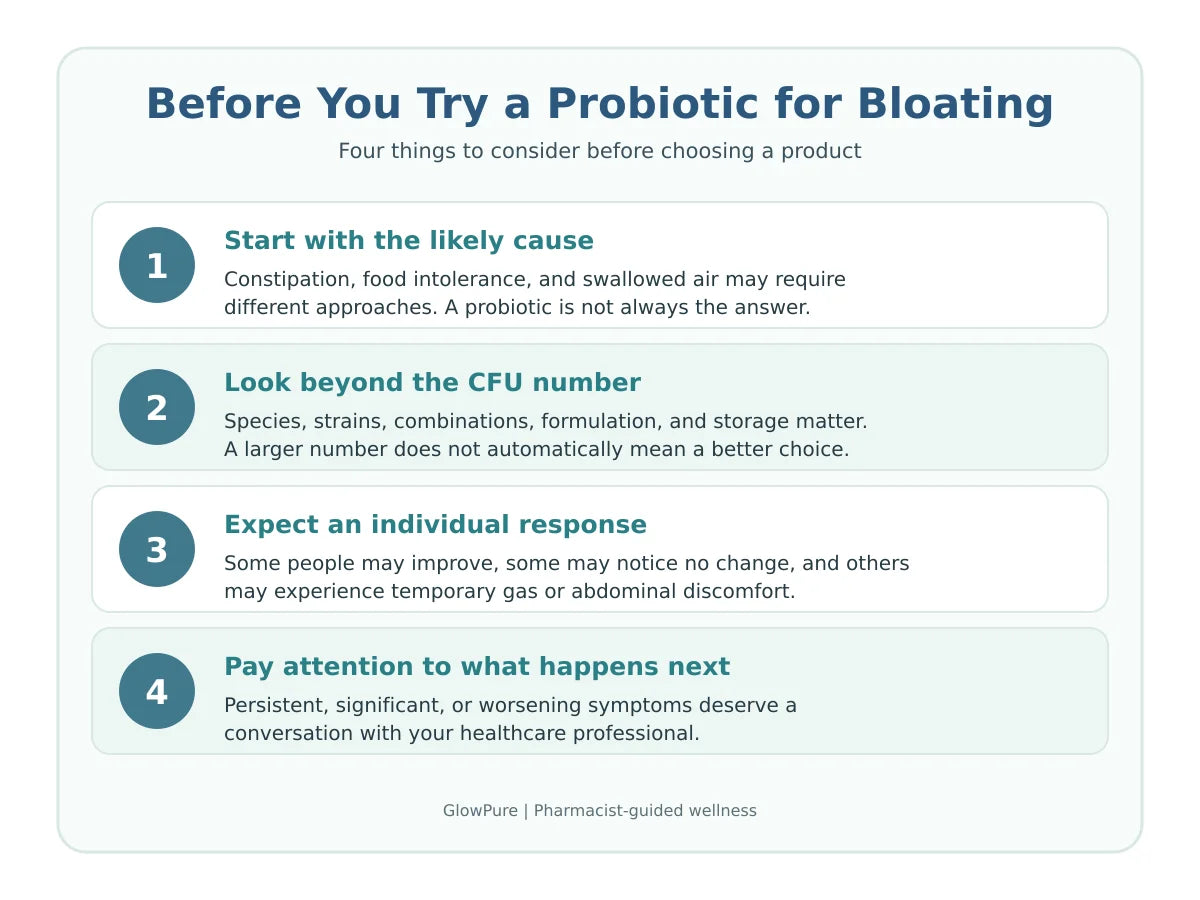
What Can Help With Bloating?
The most useful approach depends on what may be causing the symptoms. Rather than searching for one universal “anti-bloating” supplement, start with the most likely explanation.
Begin with simple eating habits
If swallowed air may be contributing, try eating more slowly, limiting carbonated beverages, and reducing habits such as frequent gum chewing or drinking through straws. Smaller meals may also feel more comfortable than large ones.
Consider constipation
If you are also having hard, infrequent, or difficult-to-pass stools, constipation may be contributing to the bloating.
Look at fluid intake, physical activity, dietary fiber, and any medications or supplements that may cause constipation. Soluble fiber such as psyllium can be helpful in some situations, but increase it gradually. Too much fiber too quickly can make gas and bloating worse.
Look for patterns rather than eliminating everything
If certain foods seem to trigger symptoms, keep a simple food-and-symptom record for a week or two. This is more useful than eliminating large portions of your diet based on a list you found online.
A structured low-FODMAP approach may help some people with IBS, but it is not intended to be a permanently restrictive diet. If symptoms are significant, consider working with a physician or registered dietitian.
If your symptoms resemble IBS
IBS can involve abdominal pain, bloating, constipation, diarrhea, or a combination of symptoms. Treatment depends on the symptoms you experience most often.
Dietary adjustments and soluble fiber may help in some cases. Enteric-coated peppermint oil has also been studied for IBS symptoms, although it may worsen heartburn or reflux and is not appropriate for everyone. Ask a healthcare professional before using it if you have a medical condition or take medications.
The important point is that “natural” does not automatically mean appropriate for everybody.
Where GILA Balance Fits
This same philosophy guided our approach to GILA Balance. It is not intended to diagnose or treat bloating, IBS, or another gastrointestinal disorder. It is a daily probiotic and prebiotic formula designed to support digestive health, healthy intestinal flora, and a balanced gut microbiome.*
Each serving provides 40 billion CFU from four identified probiotic strains:
- Lactobacillus acidophilus La-14
- Bifidobacterium lactis Bl-04
- Lactobacillus plantarum Lp-115
- Lactobacillus paracasei Lpc-37
The formula also contains fructooligosaccharide, or FOS, a prebiotic that helps nourish beneficial intestinal bacteria. MAKTREK® Bi-Pass Technology is designed to help protect the probiotics as they pass through the stomach.*
There is an important point to remember about prebiotics: because intestinal bacteria ferment them, they may also produce gas in some people. That is another reason I would never claim that every gut-health ingredient automatically eliminates bloating.
Individual response matters. If you try a probiotic, pay attention to how your digestive system responds rather than assuming that temporary discomfort or lack of improvement means you simply need a larger dose.

Pharmacist-selected digestive support
GILA Balance Probiotic
Daily probiotic and prebiotic support for healthy intestinal flora, digestive function, and a balanced gut microbiome.*
- 40 billion CFU per serving
- Four identified probiotic strains
- Prebiotic FOS to nourish beneficial bacteria
- MAKTREK® Bi-Pass Technology
- 60 capsules for a 30-day supply
Free U.S. shipping
*These statements have not been evaluated by the Food and Drug Administration. This product is not intended to diagnose, treat, cure, or prevent any disease.
What About Detox Teas and “Flat Tummy” Products?
This is where my pharmacist side comes out: be skeptical.
A tea cannot “detox” your digestive system in the way many advertisements imply. Your liver and kidneys already perform the complex work of processing and removing substances from your body.
Some detox teas and flat-tummy products contain stimulant laxatives, diuretics, or ingredients that increase bowel movements or water loss. These effects may temporarily change the number on the scale or make the abdomen appear flatter, but that does not mean the product corrected the cause of the bloating or improved gut health.
The same caution applies to juice cleanses. Claims that a product can “flush toxins,” “reset your gut overnight,” or create a permanently flat stomach within days should be approached with considerable skepticism.
Digestive health is rarely about a dramatic cleanse. It is usually about identifying triggers, addressing the underlying cause, and building consistent habits.
When Is Bloating Normal and When Should You Get Help?
Occasional bloating, particularly during or after meals, is common. It may improve within several hours as digestion progresses or after a bowel movement.
What matters most is the pattern. Feeling bloated after an unusually large meal is different from developing unexplained abdominal swelling every day for several weeks. Pay attention when symptoms are new, persistent, or different from what is normal for you.
Talk with a healthcare professional if bloating:
- Persists or progressively worsens
- Changes suddenly without an obvious explanation
- Occurs with persistent abdominal pain
- Is accompanied by unexplained weight loss
- Occurs with blood in the stool or black stools
- Is accompanied by repeated vomiting or fever
- Occurs with significant constipation or diarrhea
- Causes persistent abdominal swelling
- Is accompanied by unusually early fullness when eating
- Interferes with normal daily activities
Seek prompt medical attention for severe abdominal pain, substantial swelling with an inability to pass stool or gas, persistent vomiting, gastrointestinal bleeding, or symptoms that are rapidly worsening.
Sometimes digestive symptoms have a simple explanation. Sometimes they do not. Knowing when to stop self-treating is just as important as knowing what to try.
Frequently Asked Questions About Bloating
Can probiotics help with bloating?
Possibly, but they do not reliably relieve bloating for everyone. Results may depend on the specific probiotic strains, the individual, and what is causing the bloating. Addressing constipation, food intolerance, swallowed air, or another underlying cause may be more useful than simply adding a probiotic.
Can probiotics make you feel more bloated at first?
Yes. Some people experience temporary gas or abdominal discomfort after beginning a probiotic. Prebiotic ingredients can also be fermented by intestinal bacteria and increase gas in sensitive individuals. Speak with a healthcare professional if symptoms are severe, persistent, or concerning.
How long does normal bloating last?
There is no single normal duration. Bloating related to a meal may improve within several hours as digestion progresses. Bloating that repeatedly occurs without an obvious trigger, persists, or progressively worsens should be discussed with a healthcare professional.
What foods reduce bloating fastest?
There is no single food that reliably eliminates bloating. The better question is what is causing it. If lactose is the trigger, reducing lactose may help. If constipation or swallowed air is contributing, addressing those factors is likely to be more useful than searching for one “anti-bloating” food.
The Bottom Line
When someone asks me, “What should I take for bloating?” my first question is usually, “What is causing it?”
Probiotics may support digestive health and a balanced gut microbiome, but they are not a guaranteed treatment for bloating. Consider your eating habits, bowel regularity, food triggers, and any medications or supplements that could be contributing.
Start with sensible changes rather than a miracle product. Eat more slowly, increase fiber gradually, stay active, and pay attention to patterns. If bloating persists, worsens, or simply does not feel normal for you, talk with a healthcare professional.
Good digestive health is not built around one ingredient. It begins with understanding your body, addressing the most likely cause, and knowing when symptoms deserve a closer look.
Be well,
Pharmacist Eddie

Continue Learning About Digestive Health
- How to Choose a Probiotic: A Pharmacist's Guide
- Food Poisoning or Stomach bug? How to Tell the Difference
- Why Do I Have Diarrhea? Common Causes, What Helps, and When to Seek Care
- Why Am I Constipated? A Pharmacist's Guide to Causes, Relief, and When to Get Help
← Explore the Digestive Health Hub
References
- National Institute of Diabetes and Digestive and Kidney Diseases (NIDDK). Symptoms & Causes of Gas in the Digestive Tract.
- National Institute of Diabetes and Digestive and Kidney Diseases (NIDDK). Eating, Diet, & Nutrition for Gas in the Digestive Tract.
- National Institutes of Health, Office of Dietary Supplements. Probiotics Fact Sheet for Consumers.
- American College of Gastroenterology. ACG Clinical Guideline: Management of Irritable Bowel Syndrome.
- American College of Gastroenterology. IBS Treatment: Probiotics.
- American College of Gastroenterology. IBS Treatment: Peppermint Oil.
The information in this article is provided for educational purposes only and is not intended as medical advice. Always consult your healthcare provider before starting any dietary supplement, especially if you have a medical condition, are pregnant or nursing, or take prescription medications.